

Kuaizhou-11 Rocket Achieves Fifth Successful Flight with Eight Payloads
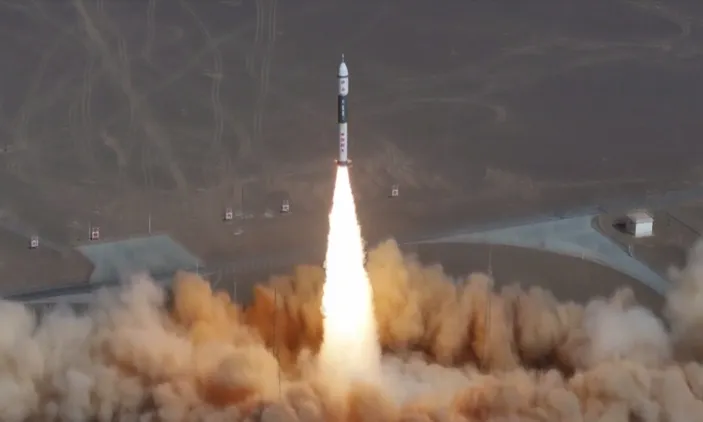
China successfully launched the Kuaizhou-11 Y7 carrier rocket on Monday from the Jiuquan Satellite Launch Center located in Northwest China's Gansu Province. This mission placed eight new satellites into their designated orbits, marking a significant achievement in the country's expanding space capabilities.
The mission was notably the fifth flight for the Kuaizhou-11 rocket, a part of the "Kuaizhou" series developed by the China Aerospace Science and Industry Corporation (CASIC). This series of small solid-propellant launch vehicles represents China's first capability for rapid integration and orbital insertion, establishing a record for the fastest launch preparation in the country.
According to Wang Peng, an associate research fellow at the Beijing Academy of Social Sciences, the transition of satellite internet from experimental infrastructure to a critical platform for consumer-grade markets is becoming apparent. This shift is influencing the commercial sector in profound ways.
Wang highlighted that trends such as increased payload capacity, reduced launch costs, and higher launch frequency are expected to define the landscape of China's commercial space sector by 2026.
The Kuaizhou-11 rocket can carry approximately one ton to a 700-kilometer sun-synchronous orbit, featuring a fairing diameter of 2.65 meters. Its ability to maintain a short preparation cycle while keeping launch costs relatively low makes it well-suited for a diverse range of commercial launch missions, as detailed by the CASIC.
The Kuaizhou series has been instrumental in enhancing China's rapid space response capabilities. In cases of natural disasters or monitoring failures, the ability to quickly launch and deploy satellites helps gather critical disaster data, thereby aiding emergency response operations.
Among the payloads in Monday's mission was the Juntian-1 04A satellite, developed by Beijing JTSPACE Technology Co. This satellite boasts the capability to independently collect millimeter-level surface deformation data, which is essential for early warning systems on geological disasters and for monitoring the safety of large-scale infrastructure.
Also included in the payload was a computing base station satellite developed by a subsidiary of the Chinese home-appliance maker Dreame, designed to assess system performance in space. The company aims to create a space-based supercomputing center, potentially deploying up to 2 million computing satellites.
Wang emphasized that the collaborative model between state-owned rocket programs and private satellite companies facilitates optimized resource allocation and efficient division of labor across the industry.
He explained that while space launches are fraught with technical challenges and risks, leveraging established state-owned launch platforms provides emerging satellite firms with more dependable access to orbit, thereby mitigating entry risks. Meanwhile, the agility of private firms in the satellite manufacturing and application processes enhances market responsiveness.
This synergistic relationship is propelling a consistent and progressive evolution in China's commercial space ecosystem, fostering a competitive edge on the global stage.
Reflecting this growth, China now boasts over 600 commercial aerospace enterprises that span the entire industrial chain—from rocket and satellite manufacturing to launch services and satellite operations.
Read These Next

Oil Prices Climb Amid Iran Tensions
Rising oil prices attribute to geopolitical tensions in the Middle East, particularly between Iran and its Arab neighbors. Analyzing market signals, corporate strategies, and macroeconomic implications provides insight into potential future trajectories for energy investors.

Middle East Tensions Disrupt Global Supply Chains
Geopolitical tensions in the Middle East disrupt global supply chains, affecting agriculture and industry, urging companies to adapt.

Unilever and Kraft Heinz Explore Merger to Unite Ketchup and Mayonnaise
Unilever and Kraft Heinz are discussing a merger of their ketchup and mayo businesses to boost efficiency and competitiveness.