

Patagonia's Earth Usage Fee on Tmall Sparks Chinese Shopper Backlash
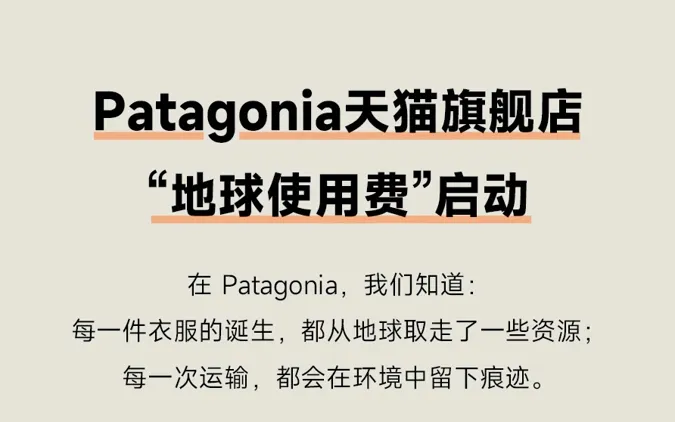
Patagonia, the renowned outdoor apparel brand based in the United States, has stirred significant online controversy following the introduction of its "Earth usage fee" on Tmall, a leading Chinese e-commerce platform. This policy, which took effect on Wednesday, has prompted a heated debate among Chinese consumers regarding the balance between sustainability and business ethics.
The announcement was made via the Chinese social media platform RedNote, where Patagonia elaborated on its new shipping policy. Under this policy, shoppers at Patagonia's official Tmall flagship store are charged 15 yuan for shipping the first item and 5 yuan for each additional item. Notably, the shipping fee will be refundable if the items are not returned; however, a deduction of 15 yuan applies if returns or exchanges are processed.
In a further commitment to environmental initiatives, the company asserted that all unrefunded shipping fees would be donated to the environmental program "1% For The Planet" managed by the SEE Foundation. This approach is reflective of Patagonia’s broader mission to foster sustainability within business operations.
The company indicated that the rationale behind implementing the Earth usage fee stems from its significant return rates, which peaked at 69.7 percent during the 2025 Double 11 shopping festival. Patagonia highlighted that shipping from its Tmall store produced over 190 tons of carbon emissions, with an additional 40.9 tons attributed to returns, reinforcing its position on the environmental impact of online shopping.
Patagonia emphasized that the Earth usage fee is intended not as a punitive measure but as an invitation for customers to consciously evaluate their purchasing decisions. The brand aims to encourage consumers to reconsider their buying habits before confirming transactions or opting for returns.
Despite the environmental messaging intended to resonate with shoppers, feedback has largely skewed negative. A number of consumers have criticized the policy, with some arguing that it unfairly shifts logistical costs onto customers and claiming that Patagonia is leveraging environmental themes as a facade for profit generation.
Others have pointed out the absence of shipping insurance at Patagonia's Tmall store for the past two to three years, a service which typically allows for returns without shipping fees under specific conditions. In contrast, Patagonia’s Australian website continues to offer such returns free of charge.
This disparity in policies across different markets has raised eyebrows among consumers. Some argue that the company's commitment to environmental causes should extend to absorbing shipping costs rather than placing the burden on consumers, labeling the move an "absurd excuse".
While a segment of consumers recognizes the underlying message regarding resource waste, many feel uncomfortable with being labeled as "environmentally irresponsible" for returning items that do not fit. The sentiment surfaces a larger conversation about consumer behavior and the implications of e-commerce.
In response to the ongoing backlash, users on social media have noted that effective environmental protection may require companies to shoulder more of the costs associated with online shopping rather than imposing them on consumers. Patagonia has historically embedded environmental protection within its core identity, aiming to attract environmentally-conscious consumers.
Interestingly, media reports indicate that Patagonia has opted to forgo participation in major Chinese shopping events, such as Double 11. Instead, it is advocating a philosophy of "buy less, think more," signifying a strategic shift in its marketing and customer engagement strategy.
Read These Next

Germany's Fuel Price Regulation: A Double-Edged Sword
Germany has enacted a new regulation to limit gas station fuel price hikes to once per day amid rising global oil prices and supply uncertainty.

Cayler Oil Fund Reports 18% Return for March 2023
Cayler Oil Fund reported impressive 18% earnings in March, reflecting strong energy market strategies and growth potential.

Insights on Sichuan Fulinyunyi Group's Ownership Transition
Discussion of the significant ownership change in Sichuan Fulinyunyi Group and its implications on market valuation, risks, and corporate governance.