

Chinese Space Firm Aims for SQX-3 Maiden Launch in 2026
China's commercial aerospace company iSPACE has announced that its self-developed SQX-3 carrier rocket is slated for its maiden launch in 2026. This initiative is geared towards enhancing China's commercial space capabilities and competitiveness in the global market.
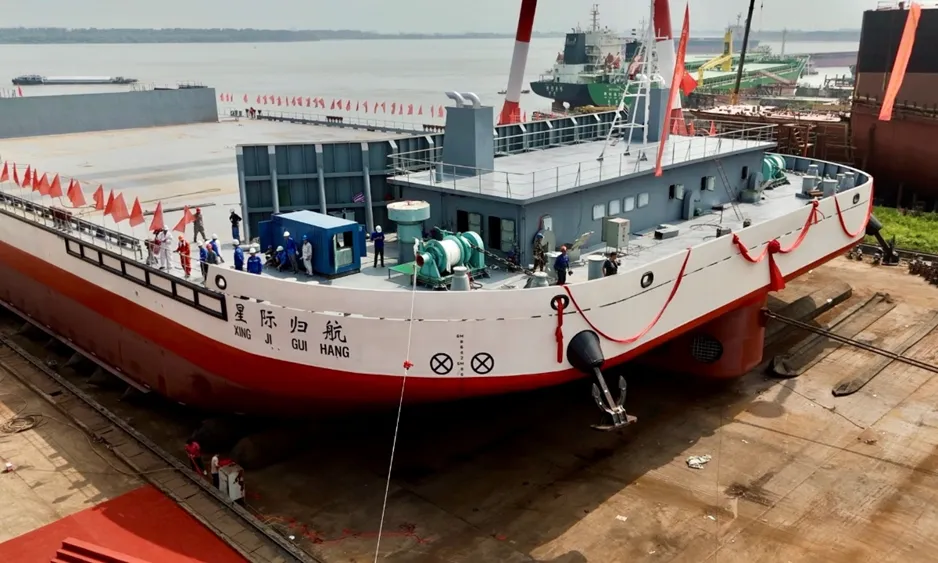
The upcoming mission will feature the SQX-3 executing its first orbital insertion alongside a sea-recovery flight test from Hainan Province in South China. Notably, the rocket is designed to perform vertical takeoff and landing recovery on a specialized recovery vessel that the company has developed.
This facility marks a significant milestone, being China's first and the fifth maritime rocket recovery ship globally. Consequently, China has joined the United States as the second country capable of such recovery operations, according to iSPACE.
Experts suggest that sea-based launch and recovery operations will provide greater flexibility in selecting launch sites. This could enhance mission adaptability, alleviate limited launch capacity challenges, and enable rockets to transport heavier payloads, explained Wang Yanan, editor-in-chief of Aerospace Knowledge magazine.
Measuring 77.8 meters in length and weighing 608.4 tons at liftoff, the SQX-3 rocket utilizes a liquid oxygen-methane propellant. It can deliver payloads of 8.5 tons to a low-Earth orbit of 200 kilometers while employing stage recovery, or up to 14 tons in expendable mode.
This launch vehicle is engineered to support high-frequency, large-scale space transport missions, including satellite constellation deployments and cargo deliveries to space stations, ultimately enabling both reduced launch costs and an increased launch cadence.
The increasing prevalence of sea-based launches indicates that China is establishing a reliable and scalable launch service capability. This progression is deemed significantly more impactful for commercialization than isolated technological advancements, as emphasized by Yang Kewei of the Commercial Space Research Center.
Furthermore, sea-based operations encourage thorough coordination throughout the value chain, transforming isolated launch projects into standardized service offerings, which in turn accelerates the industrialization and growth of China's commercial space sector.
The planned launch attempt by iSPACE aligns with a broader narrative of vibrant growth in China's commercial space sector. In 2025, the country's commercial aerospace industry completed 50 launches, representing 54 percent of all launches conducted that year.
With recent attempts in reusable rocket recovery, such as LandSpace's Zhuque-3 rocket and the Long March-12A Y1 carrier rocket, China is making strides in reusable technology, despite some challenges in achieving full recovery.
As outlined in the 2026 Government Work Report, China is poised to accelerate new growth drivers spearheaded by the aviation and aerospace sectors. Anticipated breakthroughs in reusable technology and innovative recovery concepts are expected to unfold, signaling a robust future for China's commercial space industry.
Wang predicts that the momentum within the commercial space sector will continue into 2026, marked by increased launch frequencies and expanded mission volumes, as Chinese companies strive to enhance market presence amid rapid global commercial space expansion.
Read These Next

Meta Plans to Cut Workforce by 20 Percent
Meta plans large-scale layoffs affecting 20% or more of its workforce, reflecting industry challenges amid economic slowdown.

Oil Prices Surge Past $100 Amid Iran Conflict
This article offers an analysis of the rise in global oil prices triggered by the war in Iran, exploring market implications, historical comparisons, and potential economic outcomes.
China Stresses Safe Global Supply Chains for Critical Minerals
China urges collaboration to maintain global supply chain stability amid US, EU, and Japan's critical minerals agreements.