

Ningbo's Marine Economy Shifts from Fisheries to Clean Energy
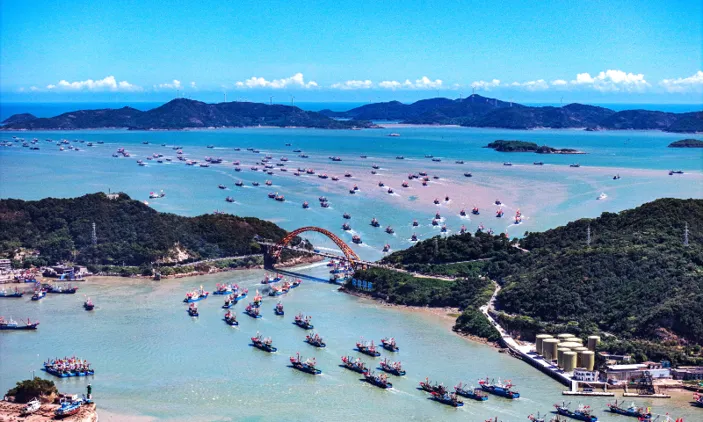
Ningbo, a port city in East China's Zhejiang Province, is advancing its marine economy by diversifying into aquaculture, clean energy, and manufacturing, enhancing its competitive edge on the global stage. The city is pivoting away from traditional fisheries and embracing innovative methods to tap into marine resources, reflecting China's broader goal of high-quality development and modernization.
With an extensive coastline of 18,000 kilometers and maritime jurisdiction covering approximately 3 million square kilometers, China stands as a formidable maritime nation with immense potential for marine economic growth. To emphasize the importance of this sector, the Global Times has launched the "Blue Momentum" series, which will showcase various marine economic initiatives across the country, with the first installment focusing on Ningbo.
At the forefront of Ningbo's marine economy transformation is the Donghai No. 1 platform, China’s first deep-sea semi-submersible aquaculture platform. Positioned approximately two hours by boat from Ningbo, this platform represents a significant technological advancement, allowing fish farming to occur in deep-sea environments. The platform not only embodies a shift in the local fishing industry but also reflects Ningbo's evolution from a traditional trading port to a thriving hub for high-tech marine ventures.
Highlighting this shift, Zhou, a former traditional fisherman, now thrives as a high-tech aquaculture worker on the Donghai No. 1. His transition is indicative of the successful integration of modern technology in local fisheries, allowing for efficient production of high-quality yellow croakers. This platform boasts impressive production capabilities, yielding approximately 400 tons of fish annually, generating an output value nearing 40 million yuan or about 5.8 million dollars.
Beyond aquaculture, Ningbo's marine economy is also diversifying into renewable energy. Nordic Aqua's land-based salmon farming project, aiming for significant production by 2027, emphasizes the global collaboration in enhancing local industries. As Asia's first large-scale land-based salmon project, it highlights its commitment to meeting China's seafood demands, backed by local government support and robust infrastructure.
In addition to fishery advancements, Ningbo's manufacturing sector exemplifies the region's global ambitions. With the Ningbo-Zhoushan Port managing record cargo throughput, the manufacturing base continues to thrive, housing numerous nationally recognized champions. Companies like Ningbo C.S.I. Power & Machinery Group exemplify the synergy between marine resources and manufacturing innovation, expanding its reach into Africa with success.
Looking ahead, Ningbo is set to further enhance its marine economy with the development of a dedicated industrial port for deep-sea wind power. Anticipated to begin operations in 2027, this project aims to create an efficient industrial chain that includes turbine assembly and core component production. This development aligns with China's goals for carbon reduction and sustainable energy.
As Ningbo navigates its future, the potential of its marine economy looks promising, with maritime initiatives contributing significantly to the city’s GDP, accounting for 15.2 percent as of 2024. Experts suggest that this growth reflects a national emphasis on quality over quantity, as China's marine strategy adapts to new development philosophies.
In conclusion, Ningbo exemplifies a broader trend within China towards a diversified marine economy, blending sustainable practices with cutting-edge technology. This transition not only positions Ningbo as a vital economic player but also sets a precedent for other regions aiming to harness their maritime resources effectively.
Read These Next

Meta and Nvidia: A Strategic Alliance in AI Hardware
This commentary analyzes the expanded partnership between Meta and Nvidia, highlighting its significance for the AI hardware market, competitive dynamics, and financial implications, while also considering future challenges and opportunities.
US Taiwan Trade Agreement Seen as Economic Trap for Taiwan
US-Taiwan trade deal faces scrutiny for harming Taiwan's economy despite reduced tariffs, raising job loss and autonomy concerns.

FTSE A50 Index Futures Rise 006 Percent for Two Nights Straight
FTSE A50 index futures rose 0.06% to 14,792 points, indicating cautious optimism in the Chinese market.