

Chinese Firm Launches Robotaxi Service in Croatia's Market
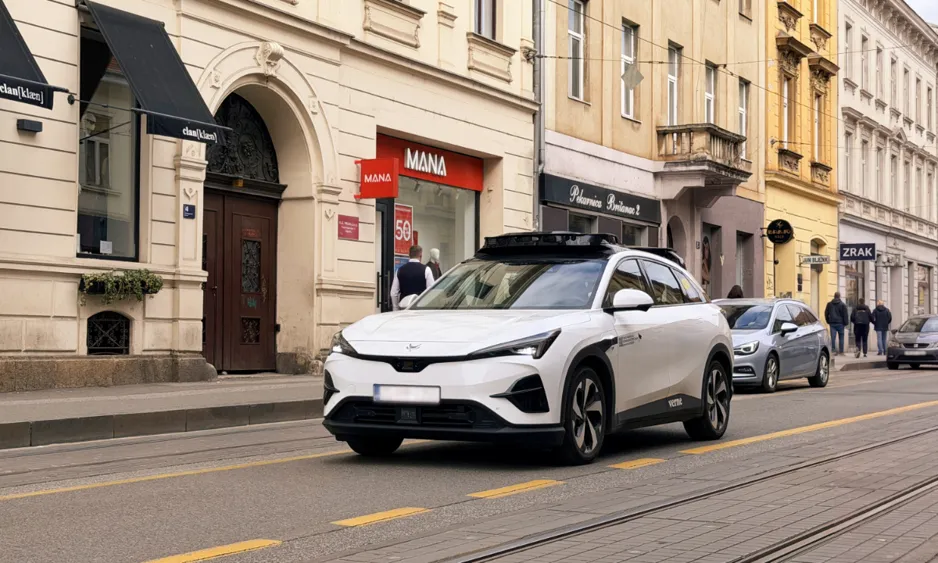
Chinese autonomous driving leader Pony.ai has launched its first commercial robotaxi service in Zagreb, Croatia, collaborating with local mobility company Verne and global ride-hailing platform Uber. This rollout marks a significant milestone as it becomes the first fully commercial robotaxi service available to the public in Europe, as reported by the Global Times.
The introduction of this service coincides with Europe's emergence as a pivotal market for autonomous driving. Chinese and European firms are developing competing yet complementary strategies to capture a rapidly growing segment within the region.
Operations officially commenced on Wednesday in Croatia's capital, with customers now able to book rides through the Verne app. Pony.ai has indicated that integration with the Uber app is planned for a future release.
Pony.ai's move into the European market reflects a broader trend among Chinese autonomous driving firms that are making noteworthy gains across the continent, which is increasingly viewed as the next essential market following extensive development and testing in the United States and China.
On March 19, WeRide, another Chinese player in autonomous driving, announced a strategic partnership with ELEVATE Slovakia to kick off Slovakia's first autonomous driving initiative. This development positions Slovakia as WeRide's fourth European market, following France, Belgium, and Switzerland.
Looking ahead, Momenta, a Chinese autonomous driving company, unveiled its plan to test Level 4 autonomous vehicles in Germany by 2026, aimed at providing safe and scalable robotaxi services in Europe and beyond.
Further expanding their ambitions, Apollo Go, the autonomous driving platform run by Baidu, has also announced plans to begin testing and offering ride services in London by 2026, contributing to the city’s goals of developing a more digital and sustainable transport system.
In the competitive landscape, European manufacturers are pushing forward as well. Volkswagen Commercial Vehicles is ramping up pre-series production of its fully autonomous ID. Buzz AD, specifically designed for robotaxi and roboshuttle purposes, anticipating the production of 500 vehicles for use in European and US projects by year-end.
The growing emphasis on autonomous driving technology in Europe, according to Zhang Xiang, a visiting professor at Huanghe Science and Technology University, reveals a landscape where both Chinese and European firms are likely to engage in mutually beneficial collaborations.
Zhang explains that Chinese companies exhibit strong capabilities in autonomous driving technology and adaptability to complex traffic environments, while European firms excel in advanced vehicle manufacturing. He notes that despite local carmakers like Volkswagen developing their own robotaxi initiatives, they currently lag in core autonomous driving technology compared to leading firms from China and the US.
According to a Boston Consulting Group analysis, by 2035, around 120,000 robotaxis are expected to operate in European cities, while predictions indicate that the US and China will lead initial market growth buoyed by supportive regulations and infrastructure developments.
The same analysis estimates the US robotaxi fleet could grow to approximately 350,000 vehicles by 2035, while China may see around 850,000 vehicles, suggesting that in a highly optimistic scenario, global adoption rates could push the number of robotaxis to around 3 million.
Read These Next

Assessing Director Independence and Its Impact on Governance
Analysis of a recent report on the independence of directors in listed companies, highlighting corporate governance trends and risks.
Wuhan Sets Meteorological Records with 138 Millimeters of Rain
Wuhan recorded 138mm of rain, breaking April's daily record and marking the earliest heavy downpour in history.

Share Issuance and Buyback: Implications for Stakeholders
An analysis of the company's recent operational changes regarding share issuance and buyback policies, focusing on implications for shareholder value and regulatory compliance.