

Maritime Transport Needs to Evolve for Sustainability and Growth
Li Ying, a prominent member of the 14th National Committee of the Chinese People's Political Consultative Conference, emphasized on Wednesday the critical need for advancements in maritime transport to bolster China's global standing. Highlighting the importance of larger, smarter, and more environmentally sustainable vessels, Li addressed these points during a group interview prior to the opening meeting of the fourth session of the committee at the Great Hall of the People in Beijing.
Li, who also serves as a professor at the Navigation College of Dalian Maritime University, pointed out that maritime transport is essential for international trade, accounting for a staggering 80 percent of global cargo volume. She underscored that robust economic growth and national strength cannot be achieved without a strong maritime shipping sector.
In discussing the concept of 'larger' development, Li noted that China boasts the largest maritime fleet in the world. This impressive scale is characterized by significant advancements that have become hallmark features in maritime equipment development, laying the groundwork for enhanced shipping capacity.
Li also referenced her research at the Shulanghu terminal in East China's Zhejiang Province, where container ships have a capacity of 20,000 twenty-foot equivalent units. Such vessels possess the capability to transport enough cargo in a single trip to meet the needs of a city with a population of 5 million. Currently, ultra-large container ships measuring nearly 400 meters are operational along domestic coastal routes.
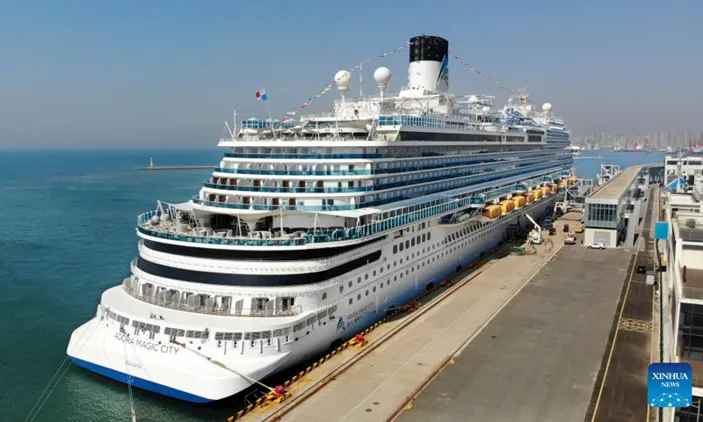
Further reinforcing China's maritime ambitions, the first domestically built large cruise ship, Adora Magic City, has recently been launched. This milestone not only signifies a significant achievement for China's shipbuilding industry but also highlights the successful development of high-end vessel types, including aircraft carriers and liquefied natural gas carriers, establishing a robust foundation for further advancements in maritime transport.
The focus on 'smarter' development represents a crucial aspect of the intelligent upgrade approach in maritime shipping. Li mentioned that the integration of advanced navigation support systems is a priority, equipping vessels with perception devices that act as their 'eyes', and implementing collaborative management systems that serve as the 'brain', enhancing operational efficiency.
The perception devices gather real-time data on sea conditions such as winds and waves, while the management system calculates optimal routes and predicts arrival times. This technological advancement allows seamless communication between ships and shore-based information, facilitating automated route planning and improving the safety and comfort of long-distance voyages.
'Greener' strategies are equally pivotal in advancing the quality of China's maritime transport. Li highlighted the rapid progression towards green ports and ships, with eight major ports, including Tianjin and Qingdao, initiating near-zero-carbon pilot projects that transition terminal operations to green energy sources.
The green transition is also evident in the shipbuilding sector, where China's orders for eco-friendly ships now represent 70 percent of the global market. Methanol dual-fuel vessels are already operational, while ammonia-fueled and fully electric ships are in development, signifying a commitment to integrating low-carbon technologies into maritime operations.
Li concluded by expressing optimism about future advancements in maritime research and the potential application of these findings to enhance shipping routes and terminal operations. The development of digital and intelligent shipping corridors aims to strengthen the safety and resilience of maritime activities, driving the sector toward more efficient global trade flows. She welcomed contributions from all sectors to support the ambition of building a strong maritime nation.
Read These Next

Meta Platforms to Develop AI Training Silicon Chips
Meta Platforms plans to develop its own silicon chips to enhance AI training and strengthen its competitive edge.

Trade data shows a unified and accessible Chinese market
China aims to unify its market by reducing barriers and boosting trade openness, creating opportunities for foreign companies.
Federal Reserve RRP Usage Reaches 877 Million on March 4
The Federal Reserve used $877 million in reverse repurchase agreements on March 4, managing short-term market liquidity.