

Lynk & Co Fixes Voice-Controlled Lighting as China's Auto Industry Pursues Safety Standards
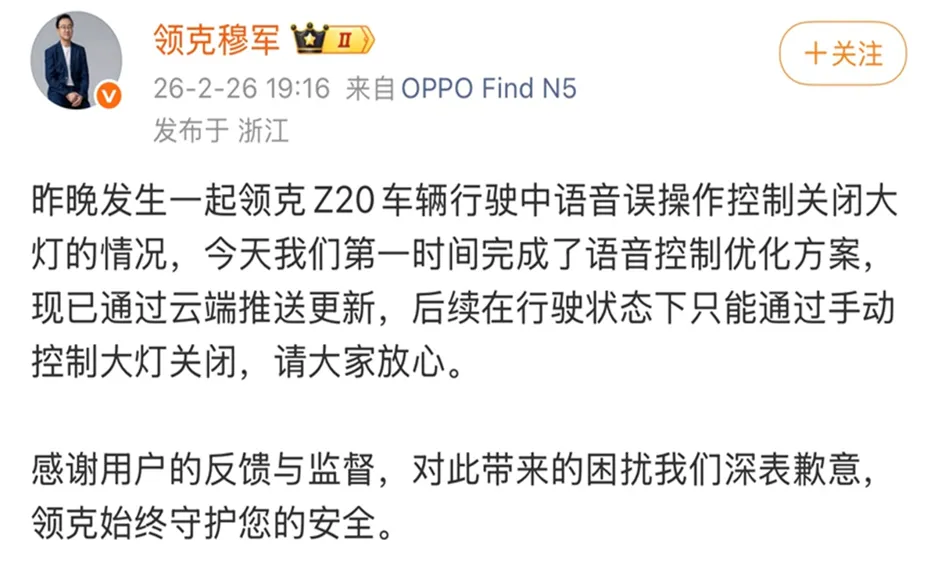
Lynk & Co, a prominent player in the Chinese new energy vehicle market, has addressed a critical safety issue involving its voice-controlled lighting system. The company issued an apology following reports that a command intended to switch off the reading light inadvertently resulted in the headlights being disabled while the vehicle was in motion. This malfunction raised significant safety concerns after a vehicle crash incident involving a guardrail, which was captured on video and shared widely on social media.
In response to the incident, Lynk & Co promptly optimized its voice control technology, delivering an over-the-air update to rectify the problem. The CEO, Mu Jun, reassured customers via a post on the company's Sina Weibo account that the update has been rolled out and that headlights would now only be operable manually while driving, thus enhancing safety measures.
Industry experts have commented that as the new energy vehicle sector in China rapidly evolves, the integration of intelligent technologies can lead to both advancements and challenges. The transition from merely stacking functions to achieving system maturity tends to expose safety flaws, which in traditional gasoline vehicles often necessitate full recalls. In contrast, electric vehicles can address many issues through real-time, cloud-based updates.
Lynk & Co's swift action has garnered some positive feedback from owners who emphasize the importance of prioritizing safety alongside the benefits of high-tech features. However, other customers expressed dissatisfaction, arguing that the incident highlighted a fundamental safety flaw that should have been avoided. They caution that even minor technical malfunctions can lead to grave consequences, particularly in high-speed scenarios.
Commentators have pointed out that the core of the issue lies in whether this safety problem is comprehensively addressed to avert future incidents. The voice-control technology, while innovative, must operate flawlessly to ensure driver and passenger safety.
Voice input technology has become an essential element of modern intelligent vehicles. Industry analysts observe that this technology, especially prominent in China's new energy vehicles, is epitomized by the Z20 model—a fully electric SUV produced by Lynk & Co.
The root of the problem was identified as a conflict within the vehicle's voice recognition and logic control system, a challenge viewed as a necessary phase in the evolution of new-energy vehicles rather than a distinct failure in product quality, according to Zhang Xiang of the International Intelligent Vehicle Engineering Association.
This incident underlines the critical need for clearer national standards and safety protocols as intelligent technologies continue to mature. A recent report from the China Society of Automotive Engineers predicts that automotive intelligent cockpits will reach a new pinnacle of cognitive intelligence by the year 2030.
Looking ahead, future intelligent cockpits are expected to move beyond simple functional stacking to create a central intelligent agent that can adapt dynamically across various scenarios, leading to a more integrated and immersive in-car experience. This shift anticipates the development of a novel intelligent service ecosystem based on collaborative multi-agent interactions.
While China's new energy vehicle industry showcases substantial progress in market scale, technological advances, and an efficient supply chain, the challenge remains to elevate safety standards in tandem with rapid technological development. Zhang underscored that enhancements in safety and thorough engineering validation are ongoing priorities for the industry.
Additionally, he noted that the development of reliable voice recognition technology—a critical focus for sustained growth—will require an extended transition, potentially taking from five to ten years or even longer to reach full operational maturity.
Read These Next

Proactive Policies Target High-Quality Economic Growth in 2026
China's 2026 economic strategy focuses on proactive policies for high-quality growth and emphasizes innovation and collaboration.

Milan Tram Derailment Claims Two Lives and Injures 49
A tram derailed in Milan on the 27th, killing 2 and injuring 49, raising concerns over public transport safety.
Pentagon and Anthropic: Shifting Military AI Dynamics
The analysis explores the intensifying conflict between Anthropic and the Pentagon, emphasizing its implications for military AI and the shifting dynamics between government and private tech companies. It highlights the necessity for balanced relationships and ethical considerations in the deployment of advanced technologies in national security.