

China Surpasses US to Become Germany's Top Trade Partner in 2025
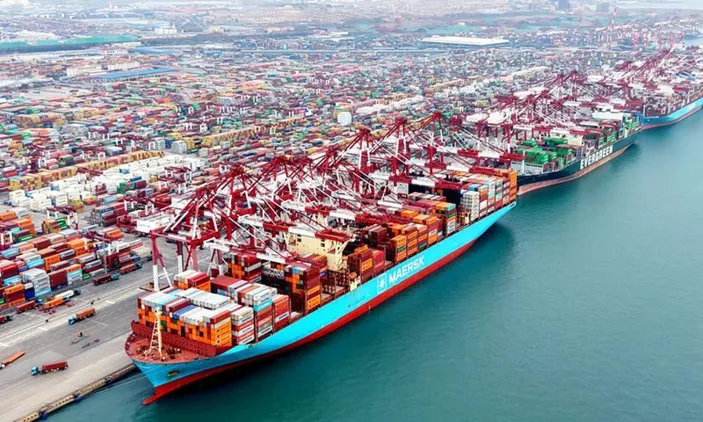
In a significant development in international trade, China has regained its position as Germany's top trading partner in 2025, demonstrating robust economic ties and favorable prospects for German enterprises. This shift highlights the evolving dynamics of Germany's trade relationships, particularly in the context of current global economic conditions.
According to a report by the Xinhua News Agency, Germany's trade volume with China increased by approximately 2.7 percent year-on-year, reaching an impressive 253 billion euros, equivalent to about 299.05 billion dollars in 2025. This surge allowed China to outpace the United States, which had held the title just the previous year.
The data revealed that Germany imported 171.2 billion euros worth of goods from China in 2025, while exports to China stood at 81.8 billion euros. This significant imbalance in trade highlights China's pivotal role in Germany's supply chain and overall economy.
Conversely, Germany's trade turnover with the United States amounted to 241.6 billion euros in 2025, indicating a decline of roughly 4.4 percent from the prior year. This downturn has been attributed largely to tariff policies enacted by the U.S., which saw German exports to the U.S. drop by 9.3 percent to 146.9 billion euros, while imports from the U.S. rose by 2.9 percent to 94.7 billion euros.
Jian Junbo, director at the Center for China-Europe Relations at Fudan University's Institute of International Studies, suggested that multiple factors contributed to China's resurgence as Germany's leading trade partner. While U.S. trade protectionism has played a role, the fundamental reason stems from a deep-seated and historical economic interdependence between Germany and China.
German investment in China reached a four-year high from January to November 2025, showcasing the confidence of German companies in the Chinese market. Jian emphasized that in the face of growing global uncertainties, the strength and stability of the Chinese economy, particularly in high-tech sectors, create a favorable environment for German firms.
In the past year, German corporations have embraced a 'in China, for China' strategy, with prominent automakers and engineering firms scaling up their investments and enhancing research and development efforts within China. This strategic pivot underscores the importance of tapping into the Chinese market.
For instance, Volkswagen Group’s China division recently launched the production of its first vehicle utilizing its China Electronic Architecture. This ambitious project is noteworthy for being the fastest turnaround Volkswagen has achieved for a new electronic architecture, taking just 18 months from concept to production.
As the U.S. exerts political and economic pressure on its allies, many Western nations, including Germany, are shifting their market strategies to diversify and nurturing a pragmatic approach toward China. Strengthening cooperation based on mutual trust can lead to mutually beneficial outcomes, as noted by Jian.
From 2016 to 2023, data from the Federal Statistical Office of Germany indicates that China held the position as Germany's largest trading partner for eight consecutive years. This trend briefly reversed in 2024 when the United States surpassed China, underscoring the fluidity of international trade relations.
Read These Next

KOSPI's Resilience: Opportunities in Trade Tensions
Commentary on the resilience of the KOSPI index amidst U.S.-China trade tensions, exploring implications for Asian markets and potential opportunities for investor optimism.
South Korean Composite Index Rises 2% to 5925.54 Points
South Korea's composite index rises 2% to a record 5,925.54, boosted by Samsung's 3% stock increase, indicating strong investor confidence.

US Trade Policy Uncertainty and Its Impact on India
This commentary analyzes the recent changes in U.S. tariff policy as it affects trade negotiations with India, emphasizing the implications of the Supreme Court's ruling and the subsequent postponement of a planned trade mission.