

Auto Exports Reach Record High in January Shows Global Competitiveness
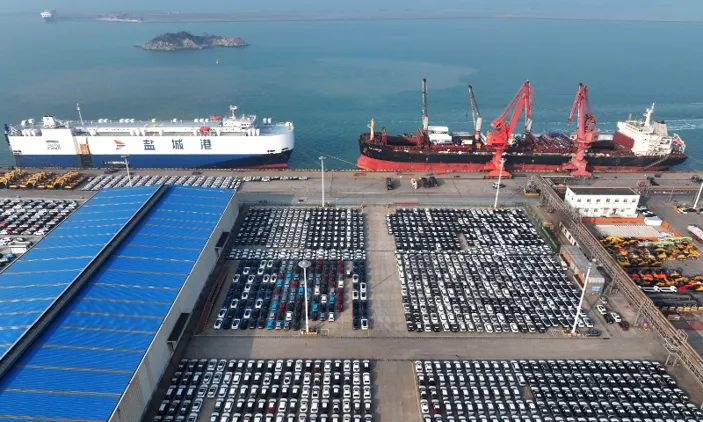
Chinese auto exports soared to historic levels in January 2026, primarily fueled by an increased appetite for new-energy vehicles (NEVs) in regions such as Europe and Southeast Asia. This robust demand underscores China's growing competitiveness in the global automotive landscape.
According to Cui Dongshu, the secretary-general of the China Passenger Car Association (CPCA), January witnessed passenger car exports reaching a record high for the month. Notably, exports of NEVs also achieved unprecedented figures for January, reflecting a significant shift in international market dynamics.
The ongoing improvements in automotive tariff discussions between China and the European Union, as well as with Canada, have transitioned NEV exports from mere vehicle sales to a more complex strategy focused on global expansion supported by comprehensive industrial chains. Cui expressed optimism that future growth will evolve from sheer volume increases to substantial qualitative advancements.
In total, Chinese car manufacturers shipped 576,000 passenger vehicles abroad in January, marking a 52 percent increase from the same period last year. Among these, NEVs accounted for 286,000 units, a remarkable 103.6 percent year-on-year surge that represented nearly half of total exports, according to CPCA data.
The rising figures demonstrate a sustained foreign interest in Chinese automobiles, particularly in European and Southeast Asian markets where NEV brands are rapidly gaining traction. Cui emphasized that this growing international market share lays a solid groundwork for prospective export expansion.
Among local manufacturers, independent Chinese carmakers exported 250,000 conventional fuel vehicles, reflecting a 17 percent increase from the previous year, along with a striking 115 percent rise in NEV exports to 226,000 units.
Of the total overseas shipments from independent manufacturers, self-developed NEVs comprised 47.5 percent, indicating a 49 percent increase year-on-year, as outlined by the CPCA.
Additionally, exports from joint ventures and luxury brands reached 100,000 units, experiencing a significant 65 percent growth compared to last year.
Cui noted that the export figures for January highlight a performance that has exceeded expectations for NEV exports in 2025, underscoring the resilience and adaptability of China's automotive sector.
In 2025, China seized a substantial 68.4 percent of the global NEV passenger vehicle market, and the footprint of Chinese manufacturers within the international automotive industry expanded to 35.6 percent as reported by the CPCA.
Despite the impressive export figures, the domestic retail market showed conventional fuel vehicles outperforming NEVs traditionally around the pre-Spring Festival period. As seasonal influences from December fade, durability in domestic NEV sales is expected to pick up in the months ahead.
In terms of domestic retail, passenger vehicle sales hit 1.544 million units in January, with 596,000 of those being NEVs, resulting in a retail penetration rate of 38.6 percent. Notably, brands like XPeng, Leapmotor, and Xiaomi have strengthened their market position, while Tesla's market share has decreased to 3.1 percent, a 1.5 percentage point drop from the prior year as per CPCA statistics.
Read These Next

AI Disruption Threatens Credit Markets
Matthew Mish of UBS warns of potential disruptions caused by AI in credit markets, predicting significant defaults among corporate loans, especially in the software sector.

Experts Warn DPP US Trade Deal is Political Pledge Not Economic Plan
Experts criticize Taiwan-US trade deal as DPP political maneuver, warning it may hinder future regional economic relations.

S&P 500 Real Estate Services Index Plunges 14 Percent This Week
The S&P 500 Real Estate Services Index fell 14% this week, the largest drop since 2020, due to high inflation and rising rates.