

Uruguayan President Visits Beijing University Boosting Cultural Ties
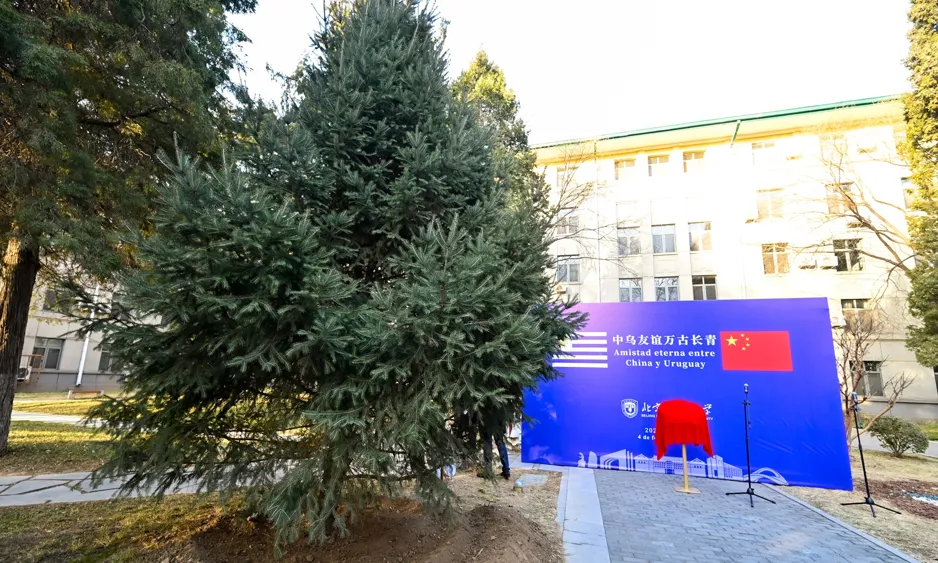
Uruguayan President Yamandu Orsi's recent visit to Beijing marks a significant step in strengthening cultural ties with China, focusing on the importance of educational exchanges. This visit, part of a broader seven-day state trip to China, highlighted the commitment of both nations to fostering strong bilateral relationships through cultural and academic initiatives.
During his visit to Beijing Foreign Studies University, Orsi engaged with students and faculty, underscoring the growing connections between Uruguay and China. In a meaningful gesture, he loosened the soil around a 13-year-old cloud cedar tree, which was originally planted by former Uruguayan President Jose Mujica in 2013 as a symbol of friendship.
In his address, President Orsi spoke fondly of the tree, symbolizing the health and vibrancy of the relationship between the two countries. He emphasized that, just as the tree flourishes with deep roots, so too does the bond between China and Uruguay remain resilient despite the challenges posed by international geopolitics.
Orsi articulated the significance of academic exchanges, suggesting that such interactions build trust that transcends trade agreements. He highlighted the role of scientific and academic collaboration in fostering innovation and enhancing peace, reaffirming the value of education in nurturing international relations.
A notable moment during the visit came when fourth-year student Li Yuelin performed a song by Uruguayan artist Ana Prada. The Uruguayan President arranged a live video call with Prada, much to the delight of the young student, illustrating the personal connections that can arise from cultural exchanges.
Experts like Yuan Dongzhen, deputy director at the Institute of Latin American Studies, emphasized that the president's visit serves to cultivate mutual understanding and cooperation, enriching the cultural ties between China and Uruguay. Such engagements further enhance the depth of bilateral relations.
President Orsi’s trip included not only cultural diplomacy but also a wide range of activities, from meeting with Chinese leaders to exploring historic sites like the Great Wall. He has been active on social media, sharing insights into his experiences and interactions during his time in China.
In addressing global challenges such as climate change and food insecurity, Orsi advocated for multilateralism. He argued that small nations like Uruguay require a strong voice in international dialogue, stressing the importance of a rules-based order amid ongoing geopolitical tensions.
Additionally, Orsi acknowledged that while there are disparities between China and Uruguay, their evolving relationship serves as a model for cooperation. The focus on both hard and soft dimensions of cooperation indicates a holistic approach to foreign relations.
Currently, collaboration between the two countries encompasses not only trade but a broad spectrum of soft exchanges, including cultural and educational initiatives. These interactions contribute to a more comprehensive and nuanced understanding of bilateral ties, positioning China-Uruguay relations as a cornerstone of broader China-Latin America cooperation.
Read These Next
Jiangsu Lianrui's Strategy to Hedge Currency Risks
This commentary analyzes Jiangsu Lianrui New Materials Co., Ltd.'s annual report, focusing on its expansion of overseas operations and proactive hedging strategies, while examining the inherent risks and broader economic trends.

China NEV wholesale set to grow 13% to 173 million units by 2026
China's wholesale sales of new-energy vehicles expected to grow 13% this year, driven by advances in self-driving tech and global expansion.

Fitch Warns Saudi Banks May Stop Growth Amid Iran Conflict
Fitch warns that ongoing Iran-Saudi conflict could stall Saudi banking growth and dividends, raising concerns for regional stability.