

Chinese SOEs Invest Over 1 Trillion Yuan in R&D for 4th Year
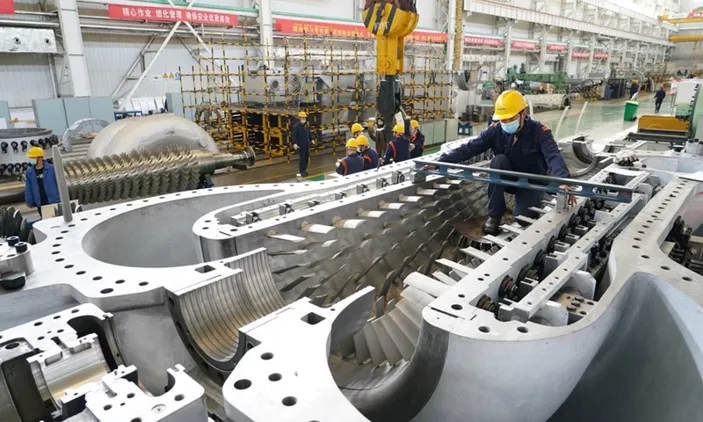
In a significant display of commitment to innovation, Chinese state-owned enterprises (SOEs) have consistently invested over 1 trillion yuan in research and development (R&D) for the fourth consecutive year. This ongoing investment is fostering strategic industry growth and promoting technological advancements across various sectors.
As per the State-owned Assets Supervision and Administration Commission (SASAC), the total assets of China's centrally administered SOEs soared to over 95 trillion yuan, translating to approximately 13.66 trillion dollars by 2025. This growth is indicative of a robust economic framework within which these enterprises operate.
Between 2021 and 2025, during the 14th Five-Year Plan period, centrally administered SOEs experienced an impressive increase in total assets from 70 trillion yuan to more than 95 trillion yuan, marking an annual growth rate of 6.9 percent, according to data from SASAC.
Cong Yi, a professor at the Tianjin School of Administration, emphasized during a recent interview that the contributions of China's central SOEs to scientific and technological innovation have become increasingly vital. Their investment in R&D is crucial as China aims for greater self-reliance in technology.
At a recent press conference by the State Council Information Office, Pang Xiaogang, deputy head of SASAC, highlighted that in 2025, the R&D spending by central SOEs reached 1.1 trillion yuan, reaffirming their continuous support for innovation as they strive for leadership in technology.
Furthermore, new initiatives in collaborative innovation were revealed, including the formation of 23 consortiums that successfully attracted over 100 new entities to tackle major technological challenges, showcasing the enhanced national strategic capabilities in science and technology.
Looking ahead, the SASAC plans to promote scientific and technological innovation actively during the upcoming 15th Five-Year Plan period, from 2026 to 2030. The focus will be on boosting independent innovation and achieving breakthroughs in core technologies that are critical for key sectors.
In support of these initiatives, a substantial fund with an initial investment of 51 billion yuan was recently established to facilitate the development of strategic emerging industries, such as artificial intelligence, advanced manufacturing, and quantum technology.
Pang reiterated that this fund aims to align with national strategic priorities, enhance industrial chain integration, and enable central SOEs to elevate their capabilities in emerging industries while supporting the broader economic goals.
During the previous year, central SOEs completed fixed-asset investments amounting to 5.1 trillion yuan and contributed 2.5 trillion yuan in taxes and fees, reflecting their vital role in supporting the national economy.
In summary, central SOEs continue to be pivotal in not only fostering innovation and technological advancements but also ensuring the long-term sustainability and resilience of China's economy amid a rapidly changing global landscape.
Read These Next
Microsoft Reports Q2 Revenue of 8127 Billion Shares Drop Over 7 Percent
Microsoft's Q2 revenue hit $81.27B, surpassing expectations, but stock fell 7% post-report amid cautious market sentiment.

Strategic Partnership for CCB Enhancing Strategy ETF
Commentary on the strategic partnership between CCB Fund Management and Zhaoshang Securities for the China Construction Bank Enhancing Strategy ETF, touching on the implications for investors and market trends.

China Approves Nvidia's H200 Chips, Key for Semiconductors
China's recent approval for the sale of Nvidia's H200 chips has had a significant impact on the AI chip market and the relations between the United States and China. Shares of companies in the semiconductor sector rose sharply following this announcement, bolstered by strong financial results from key players like ASML and SK Hynix.