

China's Decarbonization Efforts Shape Global Economy
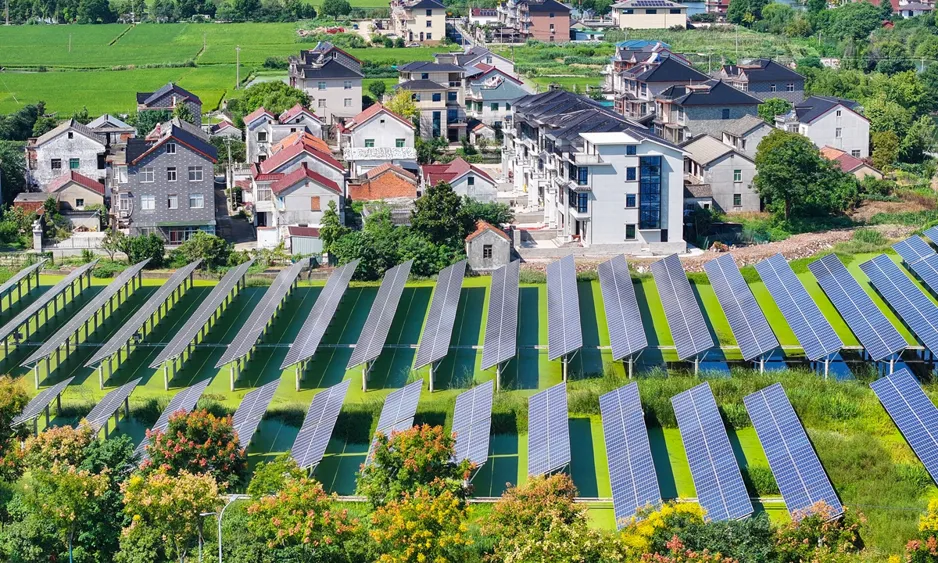
China's ongoing decarbonization efforts intertwine innovative technology with principles of a circular economy, contributing to enhanced sustainability and a significant reduction in fossil fuel dependency. These initiatives represent a commitment to integrating environmental goals within the broader framework of economic modernization.
During the 14th Five-Year Plan period, which spans from 2021 to 2025, China has made remarkable progress in facilitating a low-carbon transition while simultaneously supporting economic growth. This demonstrates a paradigm shift wherein decarbonization is not viewed as a hindrance, but rather as a vital element of holistic economic advancement. The focus has evolved from incremental efficiency upgrades towards a fundamentally transformed energy system that embraces renewable energy integration, grid enhancements, advancements in energy storage, and the adoption of digital technologies.
A clear reflection of this transformative approach is seen in China's burgeoning electric vehicle (EV) market, advancements in battery technology, and the expansion of high-speed rail networks. Moreover, there is a growing emphasis on supply chain transparency, signaling a shift towards a more accountable and data-driven green transition. Events like the China International Supply Chain Expo showcase how domestic innovations are not only scaling locally but are also beginning to influence greener supply chain models globally.
Looking forward, proposals for the upcoming 15th Five-Year Plan, covering 2026 through 2030, advocate for an accelerated green transition that aligns with the ambition of building a beautiful China. The Central Economic Work Conference has underscored the imperative of driving a comprehensive green transformation, supporting the notion that China's confidence in advancing green development is bolstered by its demonstrated capacity to implement complex systemic transitions. This is exemplified by its global leadership in renewable energy deployment, electric vehicles, and advanced grid infrastructure.
The 15th Five-Year Plan signifies a noticeable pivot from pilot initiatives to widespread transformation across various sectors of the economy, embedding the green transition into industrial enhancement, urban development, and consumer behavior. This proactive approach was prominently featured in the 'Two Lakes Dialogue' forum, co-hosted by WBCSD, highlighting Hubei Province's leadership in establishing low-carbon industrial clusters that synergize carbon market mechanisms with the incubation of green technologies.
For European companies, China's green transition presents unprecedented opportunities for deeper collaborative efforts that surpass traditional product sales or component sourcing. The rise of climate-related trade regulations prompts firms to tackle essential questions regarding how to assess and validate the carbon footprint of their products, underlining the necessity for greater alignment in this realm to facilitate smoother international trade.
This collaborative spirit is also expanding into sectors that are typically more challenging to decarbonize, such as steel production, cement manufacturing, and chemicals. Utilizing European expertise in industrial processes in conjunction with China's capacity for large-scale technological application could lead to a smoother transition from innovation testing to practical application in the real world. Increased policy emphasis on a circular economy can further bolster cooperation by harmonizing product design, usage, and restoration, thus creating new value chains where European proficiency meshes with China's manufacturing strengths.
The 15th Five-Year Plan not only highlights the critical nature of self-reliance and technological advancement but also establishes green development as a cornerstone of Chinese modernization. By prioritizing technological advancements in pursuing decarbonization, it reinforces the belief that climate objectives and economic progression can coexist harmoniously. Future innovations are poised to play a pivotal role in revolutionizing China's energy infrastructure and promoting sustainable practices.
At the core of this transition lies the ambition to develop a smarter and more resilient electrical system. The focus is evolving from merely enhancing renewable energy capacity to constructing flexible and digitally managed grids that can accommodate clean power alongside energy storage and electric vehicle infrastructure. Improvements in long-distance power transmission and grid management could serve as valuable models for other nations, particularly emerging economies.
Furthermore, reevaluations in the production and repurposing of materials are driving down costs. Through its extensive manufacturing capability, China is well positioned to render these sustainable solutions more affordable and accessible, mirroring its approach to solar energy expansion. Moreover, China's submission of its 2035 Nationally Determined Contributions ahead of COP30 underscores its proactive involvement in global climate initiatives, signifying an ongoing commitment to multilateral climate cooperation and setting absolute emissions reduction targets.
Read These Next

AI and Climate Change: Navigating Europe's Critical Crossroads
Analysis of Europe's dilemma between advancing AI technology and adhering to climate goals amidst growing energy demands and regulatory challenges.

Hubei Lab Achieves World Record with 800 km/h Maglev Breakthrough
Hubei researchers set a world record by accelerating a maglev rail model to 800 km/h, showcasing China's transport advancements.

Strong 66 Magnitude Earthquake Hits Waters off Taiwan
A magnitude 6.6 earthquake hit off Yilan County, Taiwan, on Dec 27, 2025, raising alerts and discussions on disaster preparedness.